
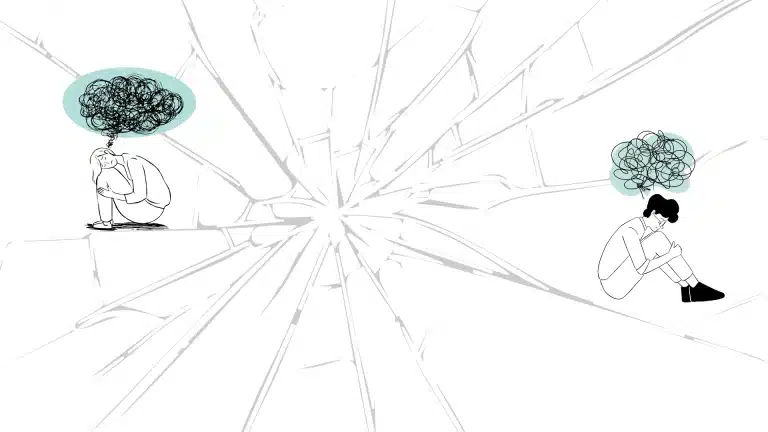






Love shouldn’t feel like a constant worry.
Yet you find yourself overthinking every text, doubting every moment of silence, and wondering if your partner really means what they say.
And if you’ve ever sat with that feeling long enough, you know it’s exhausting, not just for you, but for the relationship too.
Your mind races with “what ifs” even when things seem perfectly fine.
Relationship anxiety can turn even the healthiest connections into emotional battlegrounds. Recognizing the signs is your first step toward breaking free from this exhausting cycle.
Let’s look into it.
What is Relationship Anxiety?
Clinically, this often overlaps with generalized anxiety disorder, though it specifically centres around attachment and intimacy fears.
It’s the persistent worry about your partner’s feelings, the relationship’s future, or your own worthiness of love.
It’s a pattern of overthinking and doubt that creeps into your daily life.
You might constantly seek reassurance, misread situations as red flags, or brace yourself for abandonment.
It often has nothing to do with your partner’s actions. It stems from your own insecurities, past experiences, or attachment patterns.
Is Anxiety in Relationships Often Ignored?
Unfortunately, yes.
It often flies under the radar because people mistake it for normal relationship concerns. You might think everyone feels this way, so you suffer in silence instead of addressing it.
These are the reasons why it’s often overlooked:
- People normalize their anxious thoughts
- People feel ashamed of admitting their fears
- Some consider these concerns as overthinking
The real issue? When left unaddressed, it doesn’t just disappear. It grows stronger, creating distance between partners and turning minor moments into major conflicts.
Recognition is the first step toward healing.
Signs You’re Experiencing Anxiety in Relationships
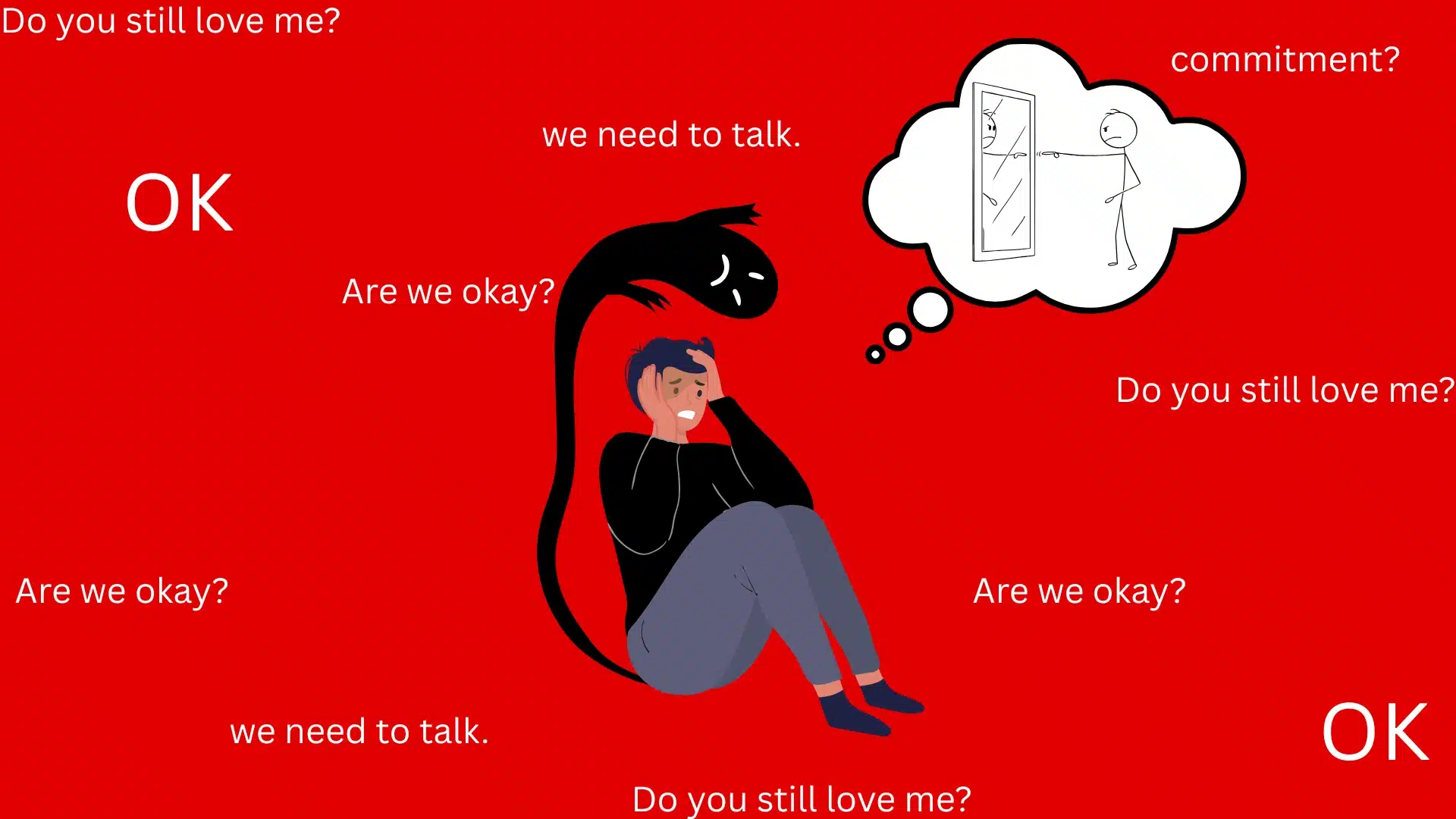
If you’re uncertain if you’re experiencing anxiety in your relationship, look out for these signs.
1. You Constantly Seek Reassurance
You find yourself repeatedly asking, “Do you still love me?” or “Are we okay?” even after your partner just told you.
One reassurance never feels like enough.
You need to hear it again and again, and again, the whole day.
What’s worth noting is that the reassurance rarely helps for more than a few minutes, which is what makes this pattern so draining for both people involved.
2. You Overanalyze Every Text Message
A simple “ok” instead of “okay” sends you spiraling.
You dissect response times, punctuation, and emoji usage like you’re solving a mystery. When your partner takes longer than usual to reply, you convince yourself they’re losing interest.
You reread your own messages obsessively, wondering if you said something wrong.
3. You Imagine the Worst Case Scenario
Your partner mentions a coworker’s name, and suddenly, you’ve constructed an entire affair in your head.
A quiet evening becomes evidence that they’re pulling away.
You pick fights over imagined slights because the anxiety needs somewhere to go. These self-created problems often become self-fulfilling prophecies.
4. You Struggle With Trust Despite No Betrayal
Even though your partner has never given you a reason to doubt them, you can’t shake the feeling that betrayal is coming.
You check their phone when they’re in the shower or scroll through their social media looking for red flags.
This distrust isn’t based on their behavior but on your own fear of getting hurt and betrayed.
5. You Compare Your Relationship to Others Constantly
You measure your partnership against everyone else’s highlight reels.
Friend’s relationships seem perfect, while yours feel fragile. You wonder why your partner doesn’t post about you as much as others do or your friends and their partners do.
Social media becomes a warzone of comparison that feeds your insecurity and makes you question everything.
6. Physical Symptoms Appear During Relationship Discussions
Your heart races when your partner says, “we need to talk.”
You get nauseous before date nights or feel chest tightness when discussing the future. These aren’t just nerves, they’re full-blown physical reactions to relationship-related anxiety.
Your body responds to relationship triggers the same way it would to actual danger.
7. You Avoid Difficult Conversations
Rather than addressing issues, you sweep them under the rug because you’re terrified of conflict.
You fear that bringing up concerns or questions will push your partner away, so you stay silent even when something bothers.
This avoidance creates distance and resentment, bringing about the disconnection you were trying to prevent.
8. You Need to Know Where They Are Always
You track their location obsessively and panic when they don’t respond immediately.
If they’re out with friends, you need updates throughout the night. This isn’t about caring, it’s about controlling your anxiety through monitoring.
You tell yourself it’s a normal concern, but deep down you know it’s excessive.
9. You Sabotage Good Moments
Things are going great, but you can’t relax and enjoy it. Instead, you wait for the other shoe to drop.
In therapy, this is often called ‘self-protective distancing,’ your nervous system creating an exit before one is forced on you.
During happy times, you find yourself picking fights or creating distance because the vulnerability of happiness feels too risky.
You’d rather control the ending than be blindsided by it.
10. You’re Hyperaware of Mood Changes
Your partner seems slightly less talkative, and you immediately assume something’s wrong with the relationship.
You monitor their emotional state like a hawk, searching for signs of discontent.
Every mood shift becomes evidence that they’re falling out of love, even when they’re just tired from work or dealing with unrelated stress.
11. You Struggle With Independence
Being apart from your partner triggers intense anxiety.
You need constant contact when separated and feel lost without them. Your identity has become so wrapped up in the relationship that time alone feels threatening rather than refreshing.
You’ve forgotten how to be comfortable in your own company.
12. You Test Your Partner’s Love
You create little tests to see if they really care.
You might pull away to see if they’ll chase you, or say you’re fine when you’re not, to see if they’ll press further.
You drop hints about breaking up to gauge their reaction. These games are exhausting and unfair, but the anxiety convinces you they’re necessary.
13. You Replay Conversations Obsessively
Hours after a discussion ends, you’re still replaying it in your mind.
You analyze every word they said and every tone they used, searching for hidden meanings. You convince yourself you said the wrong thing or that they seemed off.
Sleep becomes difficult because your brain won’t stop the mental review.
14. You Feel Unworthy of Their Love
Deep down, you believe your partner will eventually realize you’re not good enough and leave.
You view their love as temporary, like you’re just waiting for them to see the “real” you.
This unworthiness makes you hypervigilant for signs of rejection, interpreting neutral behaviors as evidence that they’re losing interest.
15. You Panic About the Future
Thinking about your relationship’s future triggers overwhelming anxiety rather than excitement. You catastrophize every potential scenario and convince yourself that things will eventually fall apart.
Commitment conversations send you into full panic mode because you can’t trust that good things can last.
The future feels like a threat instead of a promise, and it’s hard that way.
How to Deal with Relationship Anxiety?
Dealing with it isn’t about making it disappear overnight. It’s about learning to manage it.
And firstly, acknowledge what you’re feeling.
Stop trying to push the anxiety away or pretend it doesn’t exist.
- Challenge Your Anxious Thoughts: Write down your anxious thoughts and the counter-evidence. Seeing it on paper helps break the cycle.
- Communicate Without Demanding Reassurance: Let them know what you’re going through, so they understand your behavior isn’t about them. Good communication builds intimacy.
- Practice Self-Soothing Techniques: Learn to comfort yourself. Deep breathing, grounding exercises, or physical movement can help regulate your nervous system.
- Build Your Independence: Invest time in friendships, hobbies, and personal goals that have nothing to do with your partner. Rediscover yourself.
- Set Boundaries With Your Anxiety: Set aside 15 minutes to fully feel your fears, then close that window. When the time is over, acknowledge your anxiety and say, “I’ll deal with you at 7 PM.“
- Stop the Comparison Game: Unfollow accounts that trigger your insecurity. Your relationship doesn’t need to look like anyone else’s to be valid and beautiful.
- Address Your Attachment Wounds: If anxious attachment is your issue, you need to work on healing those early wounds. Read about attachment theory.
- Get Professional Support: A professional can help you identify thought patterns, develop coping strategies, and work through underlying trauma. Emotionally Focused Therapy (EFT) and CBT are two approaches that have shown consistent results specifically for relationship anxiety.
Be Patient With Yourself.Healing anxiety takes time. Be as compassionate with yourself.
What is the 5-4-3-2-1 Method?
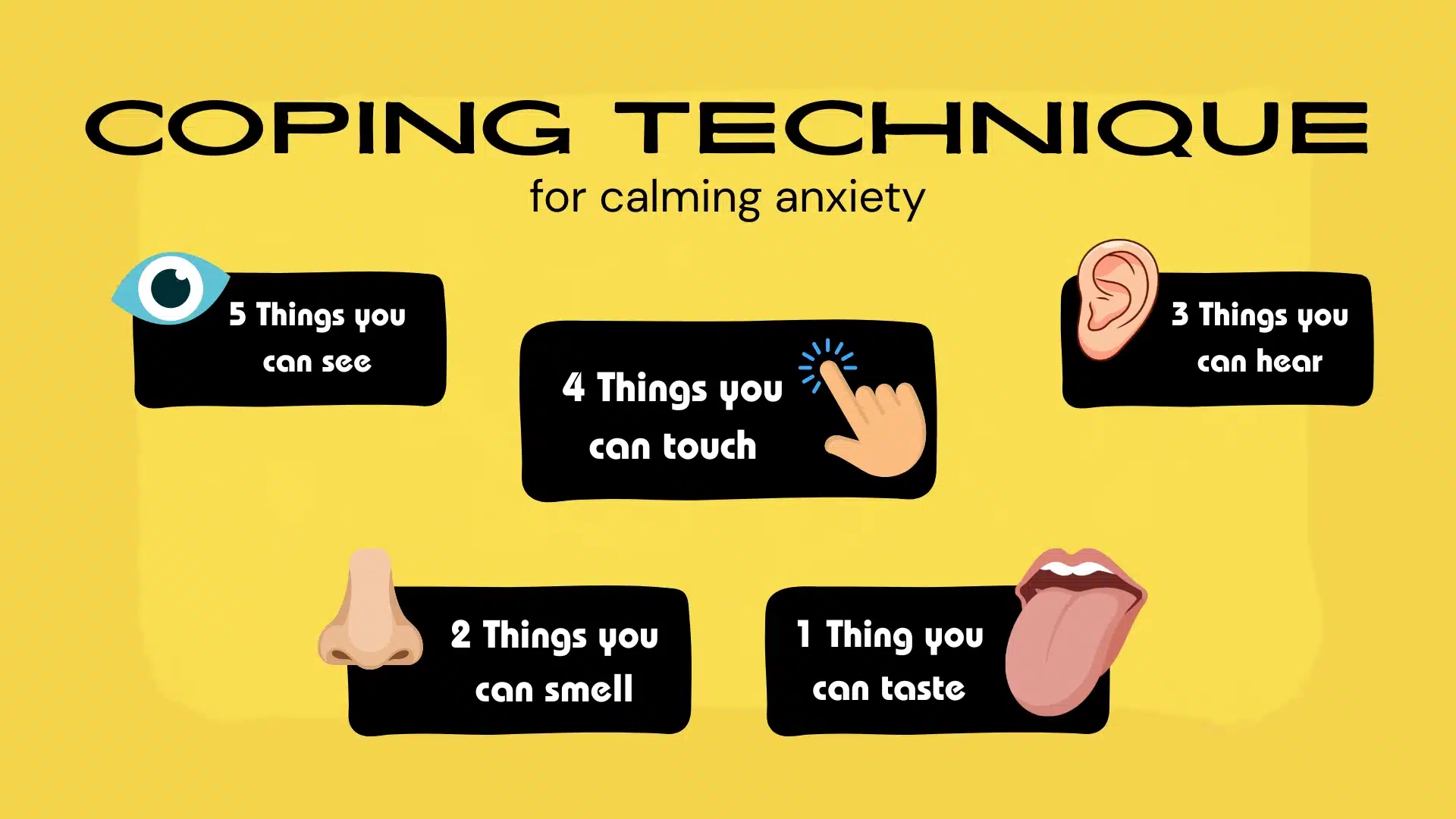
This is a well-known grounding technique commonly used in Cognitive Behavioural Therapy (CBT) to interrupt anxious thought spirals.
It works by focusing your attention on
- Five things you can see
- Four things you can touch
- Three things you can hear
- Two things you can smell
- One thing you can taste
What is Gut Feeling? Relationship Anxiety vs Gut Feeling
Your gut feeling is that instinctive sense that something’s off or right, even when you can’t explain why.
It’s your subconscious picking up on subtle cues your conscious mind hasn’t processed yet, be it body language, tone shifts, pattern changes, or inconsistencies.
Anxiety can disguise itself as intuition.
Your gut speaks once with confidence. Anxiety won’t shut up until you listen to the wrong message.
| Relationship Anxiety | Gut Feeling |
|---|---|
| Loud, frantic, and repetitive | Quiet, calm, and consistent |
| Based on fear and “what ifs” | Based on observation and patterns |
| Needs constant reassurance | Doesn’t waver with reassurance |
| Creates panic and urgency | Brings clarity, even if uncomfortable |
| Spirals into worst-case scenarios | Stays focused on specific concerns |
| Contradicts evidence and facts | Aligns with subtle red flags |
| Feels chaotic and overwhelming | Feels certain and grounded |
| Rooted in past trauma | Rooted in present reality |
A simple way to tell them apart: anxiety asks ‘what if?’ repeatedly. Intuition usually just says, something is off.
How to Deal with Your Anxious Partner?
Be patient, but don’t become their emotional crutch.
- Offer reassurance without enabling constant validation-seeking.
- Listen when they share their fears, but gently encourage them to develop their own coping tools.
- Set healthy boundaries around reassurance requests and checking behaviors.
- Suggest professional help if the anxiety is overwhelming your relationship.
- Stay consistent in your actions and words.
Remember: you can support their healing, but you can’t fix their anxiety. That’s their work to do.
Disclaimer: Nothing in this blog replaces real professional support. If these signs feel like you, please don’t ignore them. A licensed therapist is suggested, and they can offer real help.
Wrapping Up
Relationship anxiety doesn’t have to define your love life.
Recognizing these signs of anxiety is your starting point. Anxiety grows in silence and isolation. The moment you name it, talk about it, and actively work on it, you reclaim power over your relationship.
You deserve a partnership where you feel secure.
If your relationship can survive this, so can you. If you’re unsure, go visit a professional.
Frequently Asked Questions (FAQs)
1. Is Relationship Anxiety Normal?
Yes, relationship anxiety is normal. It becomes concerning when these feelings are constant, overwhelming, or start affecting your daily life and the relationship.
2. How Long Does Relationship Anxiety Last?
Relationship anxiety differs for each person. For some, it fades within weeks or months, and for others, it can last longer or return during stressful periods.
3. Is Relationship Anxiety a Red Flag?
Relationship anxiety itself isn’t a red flag. It’s often a natural response to sensitivity and past experiences.
4. What is the Relationship Anxiety Test?
A relationship anxiety test commonly has questions about your worries, fears, and behaviors in your partnership.
