
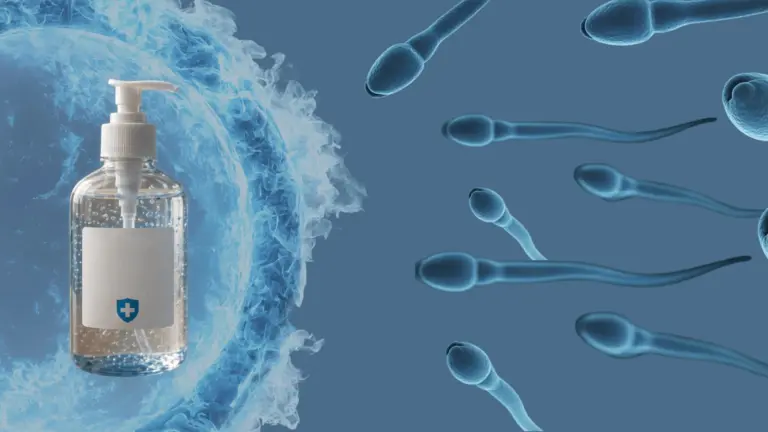






You’re in the heat of the moment, things get steamy, and oops, one of you reaches for a bottle of hand sanitizer.
But does that quick spritz break the spell of those potential swimmers? Or is it just another myth?
Hand sanitizer has become our pandemic-era sidekick, zapping germs with ruthless efficiency. But what about sperm?
Does hand sanitizer kill sperm?
It feels like a logical thought, and honestly, it’s the kind of question more people should feel comfortable asking.
Hand sanitizer was built for one job, and pregnancy prevention isn’t it.
Before you rely on something that was never designed for this, here’s what you actually need to know.
Does Hand Sanitizer Kill Sperm?
Yes, alcohol can damage sperm cells on direct contact. Hand sanitizer contains ethanol or isopropyl alcohol, and both can break down the outer layer of sperm cells.
So, in a very controlled setting, it does cause harm to sperm.
But here’s the important part: damaging sperm on a surface is a completely different thing from preventing pregnancy.
A 2013 review of spermicide research published in Contraception noted that for a substance to work as an actual contraceptive, it needs to maintain active contact with sperm inside the reproductive environment, not on skin.
Timing, location, and conditions all work against hand sanitizer here.
It’s not a contraceptive. It was never tested or approved as one.
Now You Might be Thinking – Does Hand Sanitizer Kill Sperm INSTANTLY?
Not exactly.
Hand sanitizer can damage sperm on direct contact – but “instantly” doesn’t mean “completely” or “reliably.”
Some sperm cells on the surface might be harmed. But different products have very different alcohol concentrations, exposure time matters, and none of it touches sperm that’s already inside the body.
So while there’s some real biology behind the idea, it can’t be counted on to destroy all sperm, and it does nothing once sperm has entered the body.
How Does Hand Sanitizer Affect Sperm?
Alcohol can harm sperm cells on contact, but what happens inside the body is a very different story.
The Role of Alcohol in Killing Cells
Alcohol is a strong chemical. It works by breaking down the outer membrane of cells. Sperm cells have a thin, fragile membrane, too.
When alcohol comes into direct contact with sperm, it can damage or destroy them.
This is why the idea sounds logical at first.
But the key phrase here is “direct contact.” Alcohol needs full exposure to cause that damage. A quick application to the skin does not guarantee that every sperm cell is reached or destroyed.
What Happens on Skin Versus Inside the Body?
On a surface like your hands, hand sanitizer works well. It kills most germs within seconds because it has full access to what it is targeting.
Inside the body, the situation is completely different.
Once sperm enters the reproductive tract, hand sanitizer cannot follow. The body is not an open surface.
Applying it externally after intercourse does nothing to sperm that has already moved inside. The alcohol never reaches its target.
This is where the logic breaks down completely.
Can Hand Sanitizer be Used as a Spermicide?
It might sound logical, but the answer is no. Spermicides are made for safe internal use, while hand sanitizer is not.
Even if it can damage sperm on contact outside the body, it is not reliable and can cause irritation or harm if used this way.
What Spermicides Actually Do
A spermicide is a product designed specifically to stop sperm from reaching an egg. It is formulated to be safe for use inside the vagina.
It either kills sperm or slows them down enough to prevent fertilization.
Spermicides go through safety testing. They are made to work in warm, moist internal conditions. They do not cause burns or damage to sensitive tissue.
That is what a real spermicide does.
Why Hand Sanitizer is NOT a Spermicide
It’s not safe for internal use.
It evaporates too quickly to work like a spermicide, it’s never been tested for reproductive use, and applying it near or inside the vagina can cause burning, irritation, and small tears in the skin, which actually increases the risk of infection.
That’s not a minor side effect. That’s a reason to avoid this entirely.
Can Hand Sanitizer Prevent Pregnancy? Why Does it Fail as Birth Control?

What many people do not realize is that sperm can reach the fallopian tubes within minutes of intercourse.
By the time anyone thinks to apply hand sanitizer, it is already too late.
Alcohol cannot travel inside the body. It stays where you put it. And where you put it is not where the sperm is.
Can hand sanitizer kill sperm after it has entered the body? No. It simply has no way to get there.
Sperm motility is also worth understanding here. Healthy sperm swim fast — the fastest can cover about 25 centimetres per hour inside the reproductive tract. By the time a post-sex thought like "should I use hand sanitizer?" even crosses your mind, the race is largely already run.
Risks of Misusing it:
Trying to use hand sanitizer this way comes with real risks.
- It can irritate or burn the skin around the genitals
- Applying it internally can damage sensitive vaginal tissue
- It creates a false sense of safety that may lead to bigger risks later
The most dangerous outcome is thinking it worked when it did not.
That false confidence can delay someone from getting actual emergency contraception in time.
What Actually Works to Prevent Pregnancy?
When it comes to preventing pregnancy, tested and approved methods are the only ones worth trusting.
Proven Methods
There are several safe and tested options available.
- Condoms block sperm from entering the body entirely. They are easy to use and widely available.
- Birth control pills work by stopping ovulation. Taken correctly, they are highly effective.
- IUDs and implants offer long-term protection. A doctor inserts them, and they work for years.
These methods are built for this purpose. They are tested, approved, and reliable.
Emergency Options
Sometimes things do not go as planned. That is okay. There are still options.
- Emergency contraception pills can reduce the chance of pregnancy if taken within 72 hours. Some types work up to 120 hours after intercourse.
- The copper IUD can be inserted within five days and is one of the most effective emergency options available.
If you're unsure which option is right for you, a pharmacist or sexual health clinic can help - without judgment, and often more quickly than you'd think. You don't need a GP referral to access emergency contraception in most places.
Making Safe Choices
Hand sanitizer can damage sperm on contact — but not in any way that prevents pregnancy.
It only works on the outside, and by the time it’s applied, sperm has usually already moved where alcohol can’t follow. Relying on it is a real risk, not just an ineffective choice.
If you’re ever in a situation where pregnancy prevention matters and you’re not sure what to do, emergency contraception is available, and using it quickly is what actually makes a difference.
People Also Ask
1. Can Hand Sanitizer Kill Sperm on Skin?
It may damage sperm on the surface, but it cannot prevent pregnancy in any reliable way.
2. Is it Safe to Use Sanitizer Internally?
No. It can burn and damage sensitive tissue. It was never made for internal use.
3. Does Washing with Soap Remove Sperm?
Soap cleans sperm off skin but does not prevent pregnancy after intercourse at all.
